
What did the BR data analysis discover?
On October 29, 2026, the investigative data team at Bayerischer Rundfunk published an automated evaluation of digital accessibility (report on BR24). The journalists screened roughly 2,000 web properties against essential statutory accessibility criteria, strictly auditing each domain's primary landing page. The central outcome: over 80 percent of evaluated homepages breached at least one statutory rule.
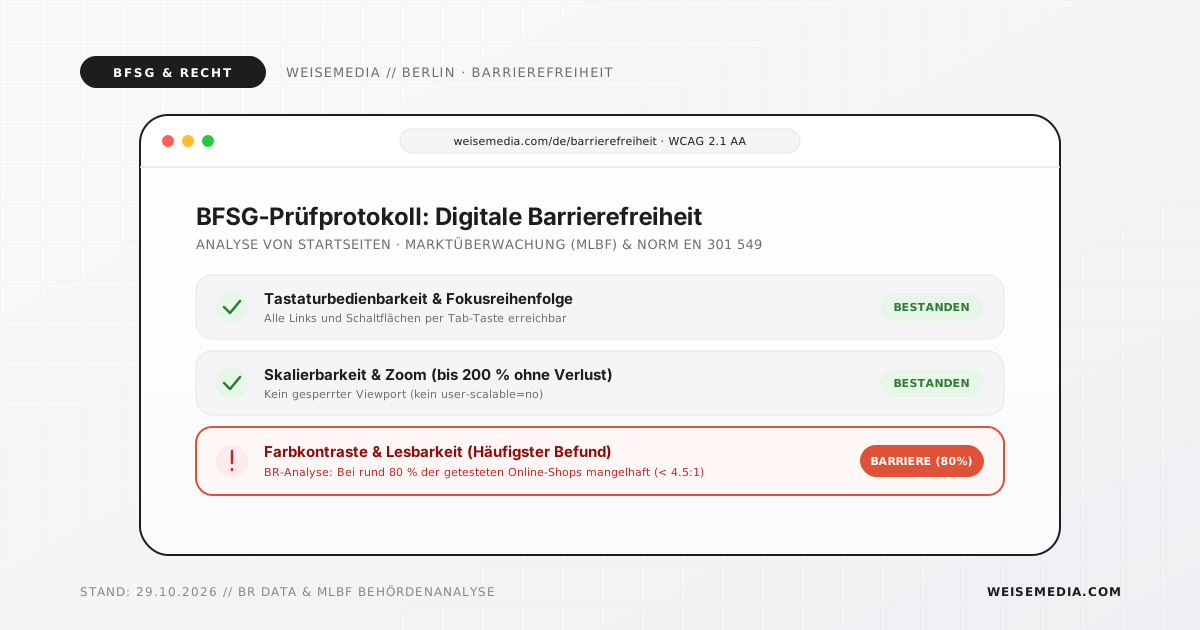
The sample spanned multiple sectors: more than 500 portals from public entities, nearly 1,300 Bavarian municipalities, and roughly 100 high-traffic consumer online shops. As an accompanying investigative report on tagesschau.de details, 86 percent of municipal websites and around 80 percent of online shops exhibited barriers. The most common deficits were insufficient foreground-to-background color contrasts and code preventing user zooming on mobile viewports.
Industry association Bitkom noted a palpable backlog in practice and advocated for pragmatic guidelines and legal certainty for businesses. Crucial qualification: automated tests evaluate only a subset of technical requirements and cannot substitute for manual or legal audits. The metrics reflect tested homepages, rather than a full census of all websites across Germany.
Is the BFSG being actively enforced?
The Accessibility Strengthening Act (BFSG) has been in force since June 28, 2025 (pursuant to Section 38 BFSG), requiring businesses to provide consumer digital services—notably e-commerce under Section 2 BFSG—in an accessible format.
Supervision for digital services is led by the Market Surveillance Authority of the Federal States (MLBF) in Magdeburg. According to official disclosures released August 13, 2026 via FragDenStaat (status August 7, 2026), the authority logged 407 submissions regarding service provider obligations (§ 14 BFSG, 257 concluded). Additionally, 377 technical audits were launched, 194 consumer submissions processed (41 concluded), and 80 exemption notices (§§ 16/17 BFSG) recorded.
Speaking to BR in late October 2026, the MLBF confirmed that it has not yet levied administrative fines nor prohibited online shops. Instead, the authority has achieved cooperative remediation of non-compliant barriers in nearly 300 instances.
What fines does the law prescribe?
Under Section 37 BFSG, statutory infractions constitute regulatory offenses subject to two tiers of maximum fines:
| Statutory Offense / Infraction Type | Statutory Fine Limit |
|---|---|
| Non-compliance with enforceable orders of market surveillance (§ 37 para. 2 in conjunction with para. 1 no. 12) or continued provision of non-compliant services contrary to § 13 para. 1 (§ 37 para. 2 in conjunction with para. 1 no. 6) | Fine up to €100,000 |
| Breaches of information, notification, or documentation duties toward the authority (§ 37 para. 1 nos. 2–5, 7–11) | Fine up to €10,000 |
Exemption for Microenterprises: Under Section 3 para. 3 BFSG, digital service obligations do not apply to microenterprises. According to Section 2 no. 17 BFSG, this encompasses businesses employing fewer than 10 persons with annual turnover or balance sheet total not exceeding €2 million.
Whether a purely informational corporate website without transactions falls under the BFSG cannot be answered generically and requires legal verification in individual cases.
What does this mean for your business?
Our Assessment: The enforcement record demonstrates that the regulator currently prioritizes dialogue, remediation notices, and cooperative resolution over punitive penalties. This affords businesses a practical window to upgrade systems, not an exemption from compliance. Consumers can file barrier complaints at any time, and common deficits can be fixed cleanly with sound web craft. While no studio can promise absolute legal immunity, disciplined execution minimizes exposure. Our Recommendation:
- 1Clarify applicability: Verify if your web offering constitutes consumer electronic commerce or qualifies for the microenterprise exemption.
- 2Audit key flows: Test your homepage and critical conversion paths (contact, checkout, booking) automatedly and manually via keyboard and 200% zoom.
- 3Resolve common hurdles: Fix color contrast ratios, permit mobile pinch-to-zoom, write alt text for informative images, and ensure visible focus outlines—as shown in our Accessibility Statement.
- 4Provide transparency: Publish required accessibility information regarding your digital services (§ 14 BFSG) and provide an uncomplicated feedback channel.
- 5Build accessibly from the ground up: Integrate WCAG 2.1 AA natively into any Website Relaunch or modern Next.js Development in Berlin rather than relying on brittle overlay widgets.
ACR Assistenz
Corporate Identity & accessible platform
Frequently Asked Questions
Referenced Sources & References
- BR24: BR Data Analysis – Barely Any Website Without Barriers (Oct 29, 2026) — Primary investigative report by BR Data examining roughly 2,000 website homepages(Accessed: October 29, 2026)
- tagesschau.de: Investigation into Digital Web Accessibility (Oct 29, 2026) — In-depth investigation covering commercial shops, municipalities, and public bodies(Accessed: October 29, 2026)
- Gesetze im Internet: Accessibility Strengthening Act (BFSG) — Official statute text (notably § 2 Definitions, § 3 Scope, § 14 Obligations, § 37 Fines, § 38 Entry into force)(Accessed: October 29, 2026)
- Market Surveillance Authority (MLBF Magdeburg): About Us — Mandate and scope of the joint federal-state accessibility market surveillance authority(Accessed: October 29, 2026)
- FragDenStaat: Enforcement Statistics on Digital Accessibility (Aug 13, 2026) — Official MLBF authority disclosure regarding operational caseload as of August 7, 2026(Accessed: October 29, 2026)
Would you like to know where your website has accessibility barriers? We audit your primary user journeys, explain findings clearly, and implement the technical fixes natively.

Alexander Weise is the founder of WeiseMedia on Mariendorfer Damm in Berlin. He engineers high-performance Next.js platforms, bespoke CRMs, and specialized digital flagships with an obsession for speed, compliance, and conversions.