News4 min read
Imprint Email: Why a Dead Mailbox Can Now Become Costly
The Berlin Higher Regional Court clarifies: The imprint email must accept messages. What the Amazon ruling means for business websites and compliance.
2026-11-01Read

Actionable engineering, transparent pricing frameworks, niche platform guides, and generative engine optimization by founder Alexander Weise.
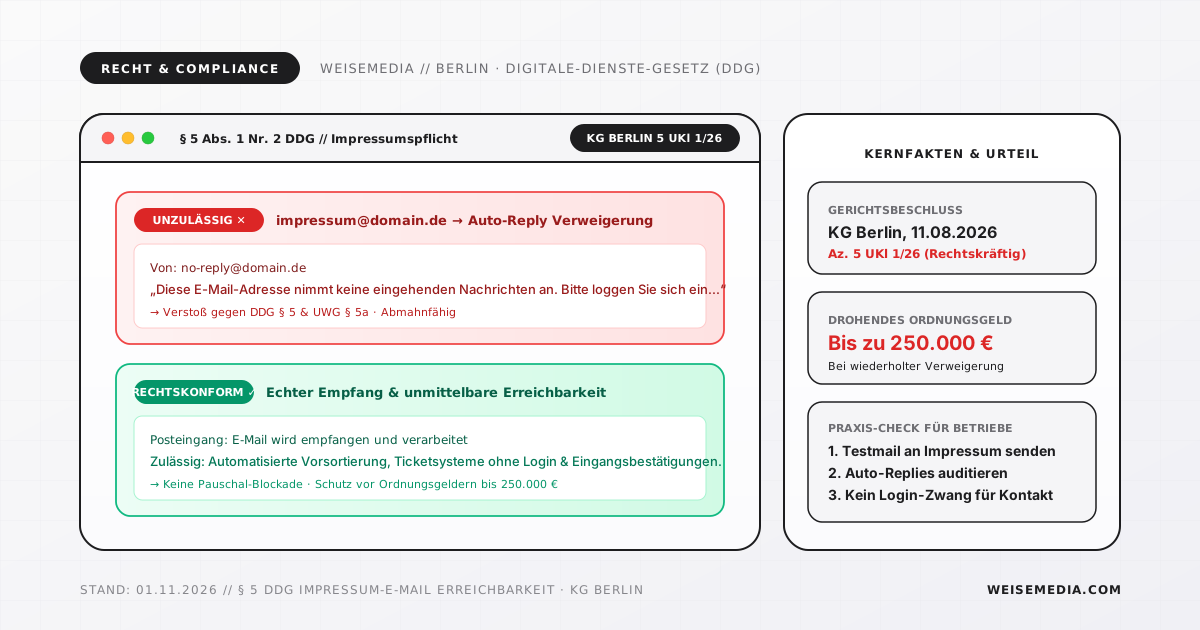
In a final default judgment rendered on August 11, 2026 (Case No. 5 UKl 1/26), the Berlin Higher Regional Court (Kammergericht) ruled that the email address stated in a commercial website's legal notice (imprint) must genuinely accept incoming correspondence. Operators who deploy automated rejection messages or require visitors to log into a customer portal breach Section 5(1) No. 2 of the German Digital Services Act (DDG), risking competitor cease-and-desist warnings and statutory fines up to 250,000 euros.
The Berlin Higher Regional Court clarifies: The imprint email must accept messages. What the Amazon ruling means for business websites and compliance.
Google, Microsoft and OpenAI plan to honor one shared robots.txt signal against AI training. What it does, when it applies and what to do now.
A BR analysis finds barriers on around 80% of tested German websites. What the market surveillance authority is doing and what businesses should check.
Google is adding more source links to AI Mode and AI Overviews, and site owners can manage inclusion in Search Console. What to check now.
The EU Council adopted its Digital Omnibus position: fewer cookie banners planned, but no new law yet. What businesses and website owners should do now.
Definitive guide for BDSM and dominatrix studio websites: discreet UX, legal requirements, age verification (AVS), and realistic budgets.
Guide to building scalable sedcard and directory platforms: multi-domain syndication, talent verification, and Next.js architectures.
Real-world web design costs in Berlin 2026: from local business sites to bespoke platforms. Direct market price comparison and interactive calculator.
Essential local SEO guide for southern Berlin: Google Business Profile mastery, sub-second speed, and customer acquisition across Tempelhof.
In-depth technical comparison: WordPress vs. Next.js in 2026. Speed, security, maintainability, and total cost of ownership.
Hospitality guide: How to convert smartphone foodies into seated guests without surrendering 15-30% commissions to aggregators.
Protect hotel margins: How boutique hotels save 15-25% in OTA commissions by mastering direct booking engines and Next.js speed.
Strategic guide: When does building a proprietary custom CRM outperform licensing HubSpot or Salesforce? TCO comparison and data sovereignty.
Master your website revamp without traffic collapse: 301 redirect mapping, metadata preservation, and Google Search Console sign-off.
Why Next.js delivers sub-second page loads: React Server Components, streaming SSR, and their direct impact on conversions and rankings.
Generative Engine Optimization (GEO) playbook: How AI search engines synthesize content and cite authoritative brand sources.
Nightlife web design guide: How cocktail bars, lounges, and clubs drive VIP bottle bookings and event ticket sales.
Web design for skilled trades: How multi-step project estimators and mobile speed attract high-margin construction contracts.
Compliance roadmap: BFSG requirements, exemptions for micro-enterprises, and WCAG 2.1 AA implementation guidelines.

Alexander Weise is the founder of WeiseMedia on Mariendorfer Damm in Berlin. He engineers high-performance Next.js platforms, bespoke CRMs, and specialized digital flagships with an obsession for speed, compliance, and conversions.