
What did the EU Council decide?
On October 21, 2026 (updated October 22, 2026), EU member states agreed on a common Council negotiating mandate on the Digital Omnibus. The Digital Omnibus is an EU legislative package designed to simplify multiple digital regulations. It bundles targeted amendments to the General Data Protection Regulation (GDPR), the ePrivacy Directive, the Data Act, the AI Act, and cybersecurity incident reporting.
Crucial context (Status: October 26, 2026): The Council position is not yet binding law, but the member states’ mandate for upcoming negotiations. As reported by heise online, the European Parliament still has to adopt its own plenary position before the Council, Parliament, and European Commission negotiate the final legislative text in trilogue talks.
What does this mean for your business?
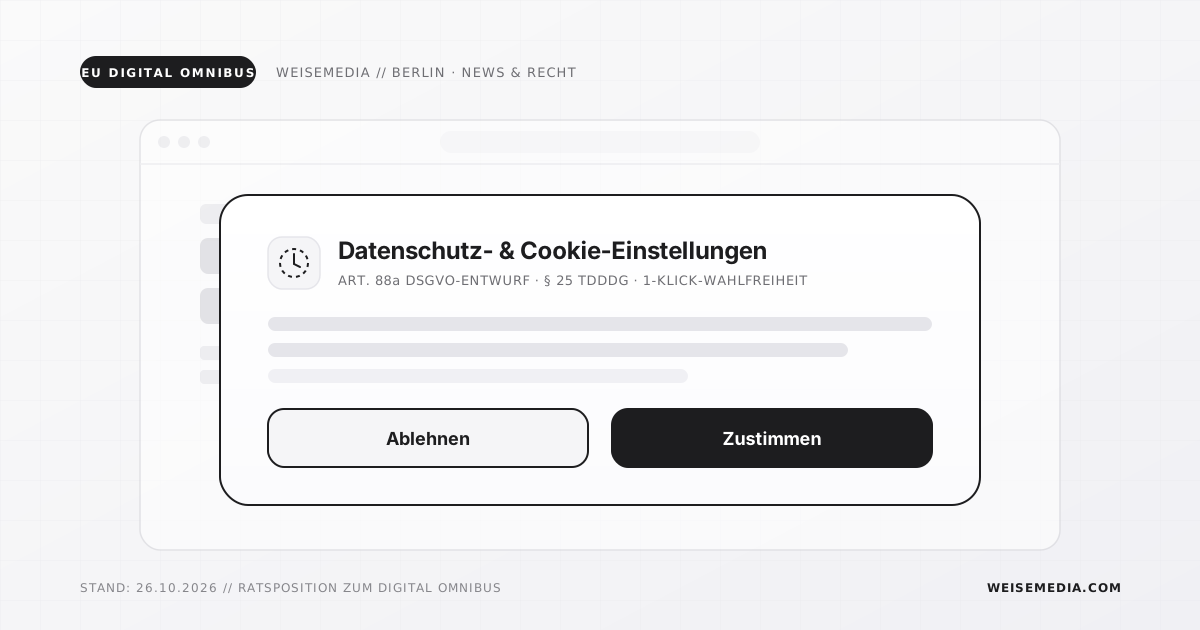
For website operators, the most important rule is simple: do not disable your cookie banner prematurely. Until trilogue negotiations conclude and the final rules take effect, Section 25 TDDDG and the current GDPR remain fully enforceable. Removing consent banners for non-essential scripts today still exposes your business to legal warnings and regulatory fines.
Our assessment: Companies that prioritize a lean, privacy-first setup during a website relaunch already benefit from faster load times today and will need minimal changes once the reform passes. Our recommendation for the coming months:
- 1Keep your current banner active: Maintain your existing consent banner with equal-weight Reject and Accept buttons.
- 2Audit third-party scripts: Review which external trackers, fonts, maps, or advertising pixels actually load when visitors open your site.
- 3Switch to privacy-friendly analytics: Favor first-party audience measurement without cross-site profiling, which aligns directly with the Council’s proposed exemptions.
- 4Wait for the final trilogue text: Schedule technical changes to your consent management setup only after the European Parliament and Council adopt the final law.
Short News: Next.js Security Update – Is Your Website Affected?
Alongside privacy rules, website owners should note an important technical release: on October 14, 2026, the Next.js team published an official Next.js security update with patched versions 16.4.1 and 15.5.28, followed by patch release 16.4.3 on October 23, 2026 (Next.js GitHub Releases). The update resolves three vulnerabilities: a High-severity Denial of Service in Server Actions triggered by crafted multipart payloads (GHSA-673q-mjm6-r5xr), a Medium-severity Open Redirect in adapter routing (GHSA-2464-fhr4-w9xw / CVE-2026-96889, CVSS 5.3), and a Medium-severity bypass of dangerouslyAllowLocalIP in Image Optimization (GHSA-p3m5-59mp-jv5r).
Our assessment: Any production website using Next.js 15 or 16—especially sites using Server Actions for forms or bookings—should be updated promptly to prevent service disruption. As a studio for Next.js development in Berlin, we offer ongoing maintenance and technical support: we audit and update your Next.js website promptly.
Frequently Asked Questions
Referenced Sources & References
- Council of the European Union: Digital rulebook – Council agrees position (Oct 21, 2026 / Updated Oct 22, 2026) — Primary source on the EU Council negotiating mandate(Accessed: 26.10.2026)
- German Federal Ministry of Justice: Section 25 TDDDG – Protection of privacy in terminal equipment — Primary source on current German law(Accessed: 26.10.2026)
- heise online: EU member states reject technical solution for cookie banners (Oct 23, 2026) — Secondary report on browser signals and trilogue status(Accessed: 26.10.2026)
- PPC Land: EU Council agrees 4-month cookie re-ask wait for Digital Omnibus talks (Oct 22, 2026) — Industry report on Council mandate document 14756/26(Accessed: 26.10.2026)
- UniConsent: Digital Omnibus Cookie Rules Overview — Supplementary industry report on proposed consent exemptions(Accessed: 26.10.2026)
- Next.js Blog: Next.js Security Update – October 14, 2026 — Official vendor advisory for Next.js 16.4.1 and 15.5.28(Accessed: 26.10.2026)
- GitHub Security Advisories: GHSA-673q-mjm6-r5xr, GHSA-2464-fhr4-w9xw, GHSA-p3m5-59mp-jv5r & Releases — Primary vulnerability advisories and Next.js 16.4.3 release notes (Oct 23, 2026)(Accessed: 26.10.2026)
Unsure which cookies and scripts run on your website or which Next.js version is deployed? We check your setup and tell you what needs action.

Alexander Weise is the founder of WeiseMedia on Mariendorfer Damm in Berlin. He engineers high-performance Next.js platforms, bespoke CRMs, and specialized digital flagships with an obsession for speed, compliance, and conversions.