
What happened?
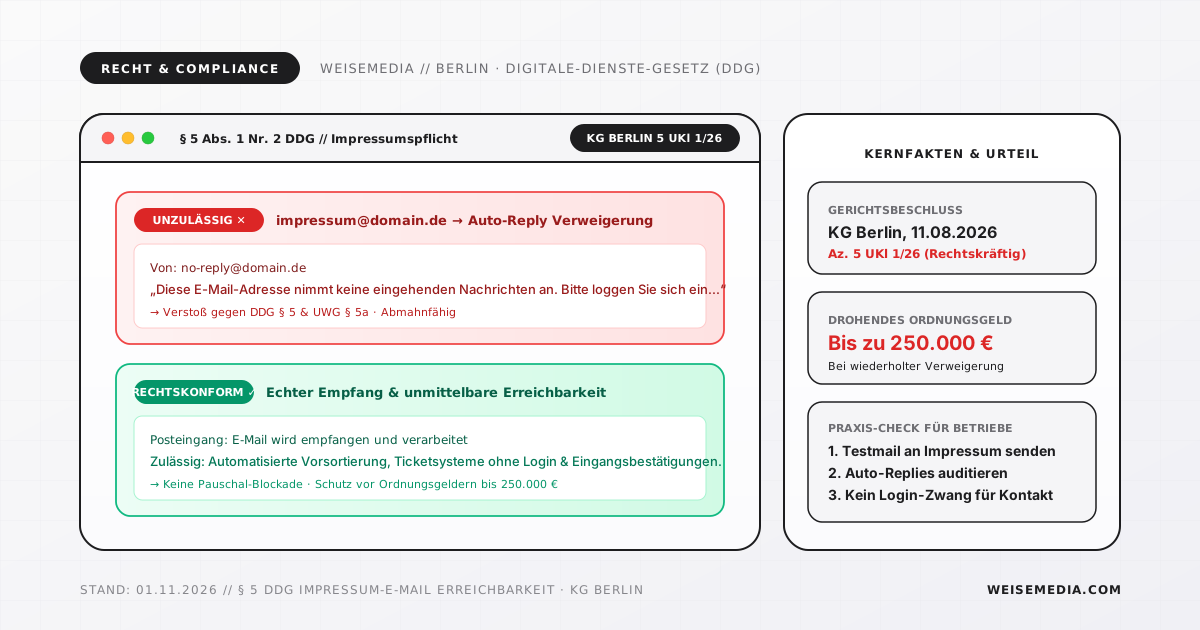
For a considerable duration, Amazon.de listed impressum@amazon.de within its mandatory corporate legal notice. However, individuals contacting this address immediately received an automated bounce message from a no-reply sender stating that inbound emails were not accepted and directing users to log into their customer account.
The Federation of German Consumer Organisations (vzbv) audited this practice with a test inquiry and issued a formal cease-and-desist warning (report on heise online). Amazon attributed the issue to an alleged configuration error but refused to sign a binding declaration with contractual penalty clauses.
The consumer watchdog subsequently filed suit. Because Amazon failed to mount a legal defense, the Berlin Higher Regional Court entered a default judgment on August 11, 2026 (Case No. 5 UKl 1/26), imposing an order backed by statutory contempt fines of up to 250,000 euros for repeat violations.
What does the law require?
The statutory baseline is codified in Section 5(1) No. 2 of the German Digital Services Act (DDG), which succeeded the previous Telemedia Act (TMG). The statute demands that service providers maintain details enabling rapid electronic communication, explicitly including electronic mail (analysis by Shopbetreiber-Blog).
The ruling reinforces precedents from the European Court of Justice (ECJ, 2008) and the Regional Court of Munich I. The Munich judges previously determined in 2025 that an unmonitored imprint address constitutes a deceptive commercial practice under Section 5a of the German Unfair Competition Act (UWG), opening website operators to litigation from trade competitors.
| Practice / Setup | Legal Assessment | Judicial Rationale |
|---|---|---|
| Inbound inbox with polite automated delivery acknowledgement | Permissible | Message is technically received; confirmation verifies successful transmission |
| AI pre-sorting, chat assistants, or ticketing systems | Permissible | Automated processing is lawful provided tickets can be submitted without login requirements |
| Ignoring unsolicited spam or phishing correspondence | Permissible | The law guarantees communication access but does not mandate replies to abusive mail |
| Automated rejection demanding login to customer accounts | Unlawful (Violation) | Refusal of communication converts the mandatory address into an unconstitutional dead mailbox |
| Overfilled quota, bounce-backs, or defunct forwarding addresses | Unlawful (Violation) | Technical unavailability breaches the permanent availability requirement under Section 5 DDG |
Common pitfalls in practice
While global enterprises easily absorb litigation overhead, small and medium enterprises frequently face disruptive statutory warning fees over unmonitored mailboxes. In web engineering and rebranding audits, we consistently identify four prevalent oversights:
- 1Orphaned Aliases: Following server migrations or staffing departures, general routing addresses (such as
info@orimpressum@) terminate into void mailboxes. - 2Dismissive Out-of-Office Notices: Auto-reply scripts instructing senders that incoming inquiries are deleted or directing them exclusively to toll hotlines.
- 3Quota Overflow: Unmonitored mail storage returning 550 Quota Exceeded errors to prospective clients and compliance auditors.
- 4Mandatory Support Logins: Ticket portals requiring users to establish password-protected profiles prior to logging inquiries.
What does this mean for your business?
Our Assessment: The Berlin judgment is an unmistakable reminder that statutory notices must function as authentic touchpoints rather than superficial boilerplate. Neglecting these endpoints invites unnecessary legal friction. Our Recommended Action Steps:
- 1Send a Test Email: Transmit an external test message from a third-party account to your public imprint address today.
- 2Audit Inbox Routing: Ensure internal responsibilities are assigned and response windows are monitored.
- 3Refine Automated Responses: Ensure auto-replies confirm receipt graciously without demanding portal authentication.
- 4Integrate During Relaunches: Ensure DNS MX configurations and routing rules are audited during every website relaunch. We maintain our own imprint with identical transparency. For guidance, reach out via our contact portal.
ACR Assistenz
Corporate platform with bulletproof compliance and verified contact channels
Frequently Asked Questions
Referenced Sources & References
- heise online: Legal setback for Amazon – Berlin Court bans fake imprint email (Aug 11, 2026) — Reporting on the Berlin Higher Regional Court default judgment against Amazon (Case 5 UKl 1/26)(Accessed: 01.11.2026)
- Shopbetreiber-Blog: Imprint email address must be genuinely reachable — Legal analysis of the immediate communication requirements under Section 5 DDG(Accessed: 01.11.2026)
- German Federal Law: Digital Services Act (DDG) Section 5 General Information Requirements — Statutory provisions mandating rapid electronic contact and email accessibility(Accessed: 01.11.2026)
Want to guarantee that your corporate web platform satisfies all mandatory legal disclosures and contact requirements? We audit digital architectures and rectify technical compliance gaps.

Alexander Weise is the founder of WeiseMedia on Mariendorfer Damm in Berlin. He engineers high-performance Next.js platforms, bespoke CRMs, and specialized digital flagships with an obsession for speed, compliance, and conversions.