
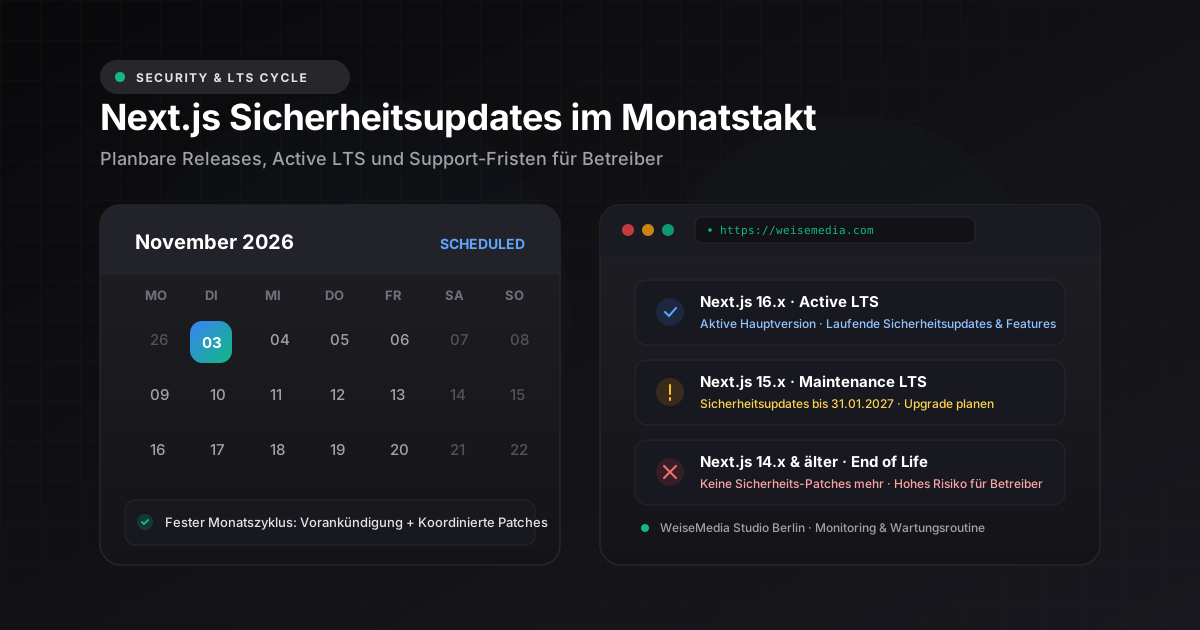
What is scheduled for November 3, 2026?
On October 27, 2026, the Next.js core team pre-announced a scheduled security release for Tuesday, November 3, 2026 (announcement on Next.js Blog). The release addresses seven vulnerabilities categorized as medium severity. Detailed advisories and affected package ranges are issued concurrently with the patches.
The approximately one-week advance notice provides development teams and infrastructure providers sufficient window to coordinate deployment schedules and prepare firewall protections.
Why are updates shipped on a fixed cadence?
On July 13, 2026, the Next.js team established a formal security release program (details on the Security Release Program). Driven by automated tooling and AI-assisted code auditing, vulnerabilities are identified industry-wide at unprecedented velocity. Scheduled monthly releases transform reactive patching into predictable maintenance.
Urgent zero-day threats remain patched out-of-band – such as on October 14, 2026, when two critical remote code execution (RCE) flaws were remediated (October security advisory). The maiden scheduled batch was delivered on July 20, 2026, via versions 16.2.11 and 15.5.21 (July release notes). Whether a specific platform is exposed depends on its active features and hosting topology.
Which Next.js versions remain supported?
The official support policy differentiates between active innovation and maintenance support (Next.js Support Policy). Under Long-Term Support (LTS), mature versions receive solely stability and security fixes over defined lifespans.
Next.js 16 represents "Active LTS", capturing ongoing enhancements and patches. Next.js 15 ("Maintenance LTS") received an extension beyond its initial October 2026 cut-off, securing patch availability through January 31, 2027. Next.js 14 and earlier branches are officially End of Life (EOL) with no further security patches.
| Version | Support Status | Security Updates Until | Recommended Action |
|---|---|---|---|
| Next.js 16.x | Active LTS | Ongoing (current major) | Deploy monthly maintenance patches regularly |
| Next.js 15.x | Maintenance LTS | January 31, 2027 (extended) | Plan migration to Next.js 16 before early 2027 |
| Next.js 14.x & older | End of Life (EOL) | No updates | Commission framework upgrade or platform relaunch immediately |
What does this mean for your business?
Our Assessment: The structured release cadence is positive news for business owners, establishing dependable maintenance predictability. However, it permanently disproves the outdated notion that websites can remain neglected after launch. Unmaintained deployments accumulate vulnerable dependencies, especially those featuring contact forms, authentication, or self-hosted servers.
To secure your digital assets, we recommend a five-stage action plan:
- 1Identify Version: Consult your engineering partner to determine the precise Next.js version operating in production.
- 2Deploy Current Patches: Update your environment promptly to the latest maintenance release and verify form handling and media delivery.
- 3Deprecate Next.js 14: If your stack relies on Next.js 14, plan an upgrade as an independent technical project. Our Next.js engineering team in Berlin modernizes legacy infrastructures seamlessly.
- 4Schedule Next.js 15 Migration: Plan your transition to Next.js 16 well before the January 31, 2027 cut-off. For older platforms, a comprehensive website relaunch often provides optimal ROI.
- 5Establish Maintenance Routines: Agree on a recurring monthly inspection routine with your agency. Explore more technical insights on our blog hub.
Noble Atlas
High-performance Next.js architecture with hardened security and continuous maintenance
Frequently Asked Questions
Referenced Sources & References
- Next.js Blog: Upcoming Next.js November Security Release (Oct 27, 2026) — Official advance notice for November 3, 2026 security release addressing 7 medium vulnerabilities(Accessed: 03.11.2026)
- Next.js Blog: Next.js Security Release Program (Jul 13, 2026) — Formalization of monthly security cadence and hosting provider coordination(Accessed: 03.11.2026)
- Next.js Docs: Official Support Policy — Lifecycle specifications: Next.js 16 Active LTS, Next.js 15 supported until Jan 31, 2027, Next.js 14 EOL(Accessed: 03.11.2026)
- Next.js Blog: Security Overview & Advisories — Central advisory directory for Next.js vulnerability disclosures(Accessed: 03.11.2026)
Unsure which Next.js version your website runs or whether the latest security update is applied? We evaluate your architecture and provide clear guidance.

Alexander Weise is the founder of WeiseMedia on Mariendorfer Damm in Berlin. He engineers high-performance Next.js platforms, bespoke CRMs, and specialized digital flagships with an obsession for speed, compliance, and conversions.